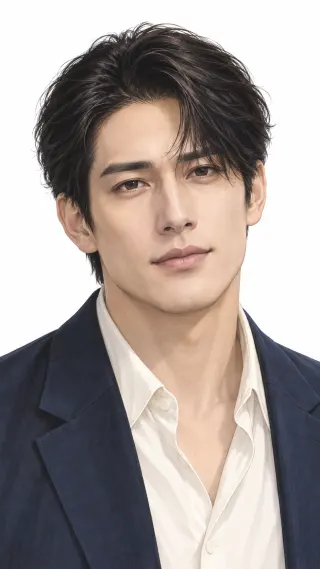
Kosuke Takami
Night observing supervisor, dedicated and steadfast.
Night Shift at the Cape Observatory · Hoshimisaki Observatory · Hokkaido, Japan
On winter night shifts at Hoshimisaki Observatory, supervisor Kosuke and survey researcher Aoi grow close through storms, outages, and late-night coffee. An image of a candidate signal brings hope, along with questions that need checking. With the observations and the station’s future still unresolved, they must also face feelings beyond work and paths that may lead to different cities.
Read the novelNight observing supervisor, dedicated and steadfast.

Survey researcher and photometry analyst, dedicated and steadfast.
[2026-01-13] At five-thirty in the evening, the northernmost headland of Hokkaido was swallowed in leaden sea mist. Roaring Pacific swells battered basalt sea cliffs, sending spray dozens of meters into the gale. Night observation chief Kosuke Takami shoved open the steel blast door of the dome corridor.
Inside the control room, red status LEDs glowed in the gloom. Survey astronomer Aoi Nomura sat before a triple-monitor console, her fingers dancing across keys as she verified pointing offsets for sixty deep-sky fields, her wool sweater framing a slender, focused profile.
"Upper winds are turbulent; seeing hovers near two point three arcseconds with high marine humidity. We will need to recalibrate our extinction coefficients," Aoi reported without turning, tracking sky metrics.
Kosuke stepped to the master panel and toggled the hydraulic dome slit. A low motor rumble vibrated through the structure as the forty-ton curved steel shutters slid apart, revealing a vault of obsidian northern heavens blazing with raw stars.
Facility engineer Daigo Narita climbed up from the basement engine bay in grease-marked coveralls, carrying an oiler and torque wrench: "Dual-feed diesel generation is locked in and fuel bunkers are topped up. Even if gales sever the grid, the dome runs for seventy-two hours."
Retired director Sohei Nagumo stood on his cane at the corridor corner, watching the fifty-centimeter Cassegrain barrel slew smoothly toward zenith. Budget cuts threatened automated shutdown, yet these younger souls stood guard like lighthouse keepers in the dark.
"Kosuke, run the primary mirror thermal balancing first," Aoi handed him hot black coffee. "Edge sensors read zero point eight degrees cooler than the core; we need the rear convection fans running for fifteen minutes."
Kosuke took the steaming mug, welcoming warmth through thick ceramic. Drive gears engaged with precision clicks. Atop this lonely promontory surrounded by howling waves, the long deep-space night shift commenced.
Aoi found hot coffee at her station, with her usual phrase written on the sleeve. She praised his observing log; he watched her smile a little too long.
[2026-01-14] At one past midnight, temperatures plunged to minus twenty-two. A Siberian polar front slammed the Hokkaido coastline, wind howling against dome steel plates like a relentless blizzard hammer.
Reiko Asano from the weather radar station entered swiftly with wind-shear printouts: "Offshore gusts have crossed thirty meters per second. Auroral ovals are drifting south; ionospheric scintillation will distort radio channels."
A pipe rattled ominously in the dome unheated gallery. Kosuke grabbed insulated mittens and a wrench, dashing through the hatch. In the minus-twenty freeze, wind encrusted his visor in frost, chilling each breath to fire in his chest.
The auxiliary CCD glycol drain valve was choked by driven sea spray ice. If not cleared, coolant would rupture circulation lines within the hour. Kneeling on frosted metal grates, Kosuke warmed the frozen housing with a heat torch.
Aoi arrived through the hatch carrying thermal silicone wraps and cable ties. She positioned herself upwind, shielding him from the brunt of the blizzard while wrapping and zip-tying insulation around the cleared housing.
"Flow rate is back to normal!" Aoi shouted through the storm, icicles dangling from her knit hood yet her voice carrying crystal clarity. Kosuke exhaled a cloud of relief as they bolted back through the airtight hatch.
Stripping off their visors, water dripped from thawed lashes. Looking at Aoi frost-flushed cheeks, Kosuke felt profound admiration and protective tenderness, handing her a warmed towel from the heater.
In sub-basement two, the diesel generator purred with rock-solid rhythm, its needles pinned to fifty hertz. The storm raged outside, yet atop this frozen headland, the observatory heart beat on unwavering.
During the blackout, Kosuke put his coat around Aoi. She leaned close to check his hands for frostbite. In the dark, only their breathing filled the room; when power returned, neither moved away.
[2026-01-14] At two-thirty, winds subsided slightly as high-altitude shearing tore open a massive clearing in the overcast. Atmospheric seeing sharpened miraculously to one point one arcseconds, unveiling pristine starry depths.
Seated at the photometer terminal, Aoi pulled frames from field HM-2026B on the Andromeda fringe. Among dense constellations of pinpoint stars, a faint target of seventeenth magnitude arrested her attention.
Archives logged the star as an unremarkable constant over three years. Yet across tonight five consecutive exposure frames, its blue-band flux dipped by zero point thirty-five magnitudes in a distinct stepped ingress.
"Kosuke, look at this light-curve ingress symmetry!" Aoi gasped, tracing the steep gradient on screen. "This is no atmospheric artifact; transit ingress took only forty minutes. A hot Jupiter transit with dense atmosphere!"
Kosuke stepped beside her, cross-referencing dark frame subtractions and flat-field calibration metrics. The data was impeccable, statistical error under three millimags: a pristine celestial candidate.
"Switch in the dichroic spectrograph immediately," Kosuke grasped the dome joystick. "We have a fifty-minute transit window before egress. We can pull sodium and water absorption lines from the twilight atmosphere!"
Guided by micro-servos, the telescope tracked with sub-arcsecond precision. As the slit centered on the faint star, spectral bands bloomed across the analyzer like a rainbow, showing distinct sodium dips at 589 nanometers.
They stood transfixed before the monitors, starglow from deep space mirrored in their eyes. Atop this promontory threatened by decommission, their singular devotion had claimed an enduring truth from the dark.
Kosuke praised Aoi’s analysis. She said she wanted his view, not her supervisor’s. He admitted she made him forget how to keep his distance. She did not laugh.
[2026-01-14] At three-forty, offshore snowfields cast a pale glare, yet a thick bank of marine advection fog billowed from the water. Creeping up cliffs with predatory speed, mist began smothering the observatory base.
The last zenith star vanished behind saturated moisture. The telescope computer tripped its high-humidity safety interlock. Kosuke pressed the close switch, drawing steel shutters tight against the fog.
Retired director Sohei Nagumo entered the control room holding a cloth-bound ledger wrapped in aged kraft paper. Moving slowly, his eyes held deep serenity as he set the worn volume on the table.
"My sky logbook since commissioning day in Showa forty-eight," Sohei stroked the frayed cover. "No star-trackers then, only reticles and mercury manometers. Yet after every thick marine fog, this cape grants thirty minutes of pure stillness."
Aoi turned pages in reverent wonder, discovering hand-sketched stellar spectra, solar flare plots, and microclimate annotations. Decades of solitary vigilance whispered through the ambered ink.
"Director, is there truly no way to appeal the automated shutdown scheduled for end of March?" Kosuke asked in a low voice, fists clenched under the console. He could not bear seeing this sanctuary reduced to unfeeling machinery.
Sohei sipped his tea and looked at Kosuke and Aoi: "Machines record pixels, but machines never weep before the majesty of a new world. Publish your discovery; this observatory will live forever in the catalogs."
Fog swirled thick outside the steel skin, yet gloom in the control room had dissolved. The old director star log shone like a lighthouse beacon, illuminating their purpose through whatever storms lay ahead.
A new researcher invited Aoi to a film in town. Kosuke said it was personal and none of his business. She asked if he truly did not care. His long silence answered for him.
At 4:15 a.m., a change in wind briefly opened the fog. Sohei’s notebook offered a comparison, not a prediction; Kosuke checked present safety conditions.
Aoi listed the survey alert as a candidate signal and checked coordinates and visibility. It was not yet a confirmed discovery.
Kosuke planned short exposures and comparison frames, retaining the option to stop if conditions worsened. A deadline did not justify uncontrolled risks.
Aoi saved raw frames with times and instrument settings. They needed calibration; a bright image did not automatically become spectral evidence.
They took turns reading checks aloud and asked again when uncertain. The dome’s sounds kept the machinery and weather present in their work.
When turbulence returned, Kosuke stopped the exposure rather than claiming instant correction. Aoi marked unusable frames without erasing the failed attempt.
The frames supported further comparison. A single image from the fifty-centimetre telescope could not resolve a distant supernova’s shock wave. The candidate remained unconfirmed.
As the sky lightened, they left questions for another check. They were relieved to have usable records, without declaring the night a settled place in scientific history.
With the exit buried by snow, Aoi admitted she might leave not because she disliked the station, but because she feared building a life with someone afraid to speak honestly. Kosuke said he wanted to go with her.
In August 2026, Kosuke reopened last winter's observation files. The candidate image that had excited them still had comparison fields left open.
Aoi separated calibration from independent confirmation. An attractive image could neither identify a supernova by itself nor resolve the structure of a distant shock wave.
After reading the notes, Sohei did not ask them to preserve a prediction. He asked for observing conditions that would distinguish a contemporary guess from evidence.
Daigo checked the backup generator and asked them to compare outage records with instrument status. Restarting equipment and accepting data were separate questions.
On August 4, Eiji delivered Yuto's camera adapter to Rumi's shop. She encouraged him to keep recording without promising what his next photograph would show.
On August 15, Shinichi and Shoko checked the sea-eagle nesting area for night-time light disturbance. The shielding still needed maintenance; one check could not validate it forever.
Reiko's weather data retained its time and source. Kosuke marked the next observation for assessment rather than treating a forecast as an order to open the dome.
Sunset touched the closed dome. No discovery had transformed the station's future that day, but the next shift had more records it could check.
While packing, Kosuke did not ask Aoi to stay for the observatory. He asked if she would take the possibility of them to the next city. She said they could begin with one date.
On August 31, Kosuke and Aoi reached the last scanning list. Completed and unfinished work stayed separate; totals did not conceal what remained.
The spring automation notice remained on file, with implementation awaiting an official response. Staffing, phased conversion, and a cooperative station each required a separate proposal.
Sohei did not claim that an observation could cancel an official notice. He listed old material he could help locate and left the decision to those responsible.
Daigo and Eiji reviewed equipment and transport needs while Rumi kept tea ready. Who would leave or stay had not become a roster approved by everyone.
Shinichi filed contact records and Shoko brought back patrol notes. Yuto documented his photography practice rather than treating curiosity as a qualification to operate major equipment alone.
Reiko reminded Aoi to check the night's weather anew. Aoi would use actual conditions and keep cancellation available.
Kosuke and Aoi parted at the door, each with a page still to finish. Aoi gestured that they could talk tomorrow. Kosuke nodded and crossed one extra task off tonight’s list.
Sea wind passed the cape without bright floodlights. Kosuke closed the door softly. A small lamp beside Aoi’s desk lit the letter awaiting an answer.
The final night’s observing ended. Aoi reached for Kosuke’s hand. They left the dome together and, for once, spoke not of star charts but where to go on their date next week.
ArkLife
Step into this world in the ArkLife app, meet its characters and begin the next chapter in your own words.
Get the ArkLife app