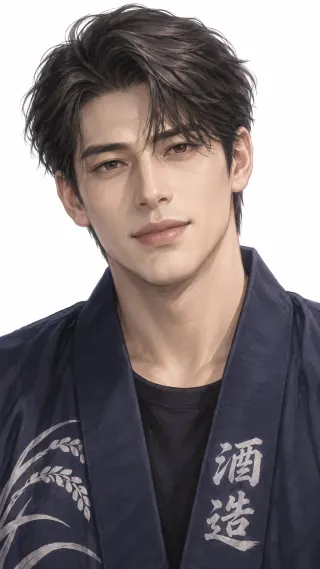
Soichiro Miyamoto
Thirty-five-year-old seventh-generation brewery head, dedicated and steadfast.
Dawn at the Winter Sake Brewery · Shiranami Brewery · Nada, Kobe, Japan
A hundred-day brewing season brings brewery heir Soichiro and yeast researcher Shioriko together at Shiranami. Quality standards and family expectations set them at odds, while late-night trials turn respect into attraction. Rice, fermentation, and unsettled shipping plans affect everyone around them. Beyond their work, there are still feelings neither has fully put into words.
Read the novelThirty-five-year-old seventh-generation brewery head, dedicated and steadfast.

Brewing technologist and yeast researcher, dedicated and steadfast.
[2025-03-15] At five in the morning at Nishinomiya Port, dry gusts falling from the Rokko Mountains whipped across weathered black-tiled roofs. Seventh-generation brewmaster Soichiro Miyamoto stepped across frost-rimmed flagstones and slid open the heavy cedar door, greeted by the tart aroma of two centuries of fermentation.
In the courtyard stood two trucks laden with hemp sacks, stacked with premier Yamada Nishiki sake rice from Hyogo Special A district. Agricultural coordinator Ryosuke Nomura jumped down breathing mist, clutching inspection sheets of thousand-grain weight and shinpaku opacity with solemn care.
Brewing technician Shioriko Sasaki hurried over in clean white workwear, carrying a portable grain moisture meter and a brass probe. She slipped the probe into the center of a sack, spilling ivory grains onto her palm to inspect the translucency of the chalky cores in the dawn.
"Moisture is fourteen point two, milling ratio thirty-five percent. The roller speeds were kept low, leaving no micro-fractures in the kernels," Shioriko nodded to Soichiro, relief and quiet satisfaction brightening her eyes behind wire frames.
Tamba master toji Genzo Asai strolled from the washhouse with hands clasped behind his back, frost clinging to his grizzled brows. He scooped a handful of rice, sniffed the cold grain, and crunched several kernels thoughtfully before offering a single nod of approval.
"This winter is make or break for Shiranamikura; the bank gave us only this single season," Soichiro spoke in low, resolute tones, eyeing the gleaming vintage vats. "We will brew a Junmai Daiginjo by authentic kimoto methods that commands global respect."
Young apprentice Kenji held his breath nearby, cold-reddened hands clutching a bamboo ladle. He had never seen such gravity in a workplace, yet the stern devotion radiating from the veteran team ignited a fierce warmth within him.
The wash valving opened with a roar as sweet, cold Miyamizu spring water surged in, whirling pure white rice into icy eddies. Shiranamikura cold brewing season began in earnest with that triumphant surge of living water.
At the blind tasting, they reached for the same glass. Their fingers touched. Shioriko did not pull away at once, and Soichiro forgot to hide his nerves behind a joke.
[2025-03-15] The thick pine hatch of the koji room was sealed fast, keeping a steady thirty-one degrees Celsius amid dense warmth. The air smelled of sweet roasted chestnuts, an ancient aroma born as mycelium colonized steaming rice.
Head koji artisan Tatsuo Morita worked bare-chested, sweat glistening along his broad back. With flat cypress paddles, he turned the grain bed with practiced grace and measured rhythm, ensuring uniform respiration across every seed.
Shioriko knelt beside the table, slipping thermocouple probes into various strata of the bed to render a live thermal topography on her tablet. The data revealed the central mycelial core was venting zero point four degrees warmer than the periphery.
"Morita-san, we need slight aeration furrows in the center, or core temperature will breach thirty-eight degrees by dawn, overproducing protease at the expense of amylase," Shioriko advised in calm, measured tones.
Tatsuo paused, lifting a clump of koji to his ear to listen to its breathing before pressing his open palm against the heat. Without glancing at the display, his hands shifted instinctively, opening three gentle ventilation channels through the center.
"Your machine is sharp," Tatsuo wiped his brow with a forearm, a rare grin touching his weathered lips. "Yet mold is alive; the dry rustle it makes when thriving sounds entirely different from when it suffocates in stagnant heat."
Watching through the double-glazed observation portal, Soichiro took in the silent synergy. The veteran instinct and young science were verifying and elevating one another over the cedar bed, the very renewal he had gambled his heritage to achieve.
By midnight, the rice surface was blanketed in uniform, frost-like mycelium, resembling early winter frost dusting stone. Tatsuo and Shioriko exchanged a weary, triumphant smile; the sugar-converting heart of Shiranamikura vintage was securely born.
Shioriko told Soichiro he treated his family name as an answer. They argued late into the night. She hated his presumption—and hated that his rare tenderness softened her.
[2025-03-15] Inside the micro-testing lab at the back of the brewery, Shioriko retrieved test tubes from cryogenic storage with steady hands. This was strain Rokko-05, a wild yeast isolated and purified from the bark of century-old apple trees on Mount Rokko.
Small fermentation Tank Five was a tenth the size of regular vats, wrapped in chilled ethylene glycol tubing. Soichiro had authorized this pilot vessel against board resistance to verify the low-temperature thresholds of aromatic kimoto brewing.
Soichiro stepped into the lab, observing the pale starter bubbling in glass beakers. A delicate breath of crisp green apple and white peach wafted from the yeast mash, breathtakingly pristine without a trace of solvent harshness.
"Its cold tolerance exceeds all predictions. It ferments steadily at seven degrees Celsius, synthesizing abundant malic acid and ethyl caproate," Shioriko pointed to gas chromatograph peaks, excitement trembling in her voice.
Master toji Genzo sampled a single droplet from a pipette, closing his eyes in prolonged meditation. Nada sake was famed for bold dryness; this luminous, fruity acidity upended traditional canons, yet his palate could not deny its breathtaking depth.
"Acidity is high; if lactobacillus gets loose, you brew vinegar," Genzo opened his eyes, stern yet probing. "On mashing day, tank temperature must start at three degrees and rise no more than half a degree per twenty-four hours."
Shioriko transcribed the lead brewer’s instructions verbatim into her control parameters. She knew cutting-edge biotechnology without the veteran keen eye for contamination thresholds would reduce the finest yeast to spilled vinegar.
The sealing hatch of Tank Five was locked down under vigilant eyes. Wrapped in cold water jackets, the vessel hummed quietly, nurturing a brewing miracle that bridged wild alpine nature and surgical discipline in the dark.
Soichiro burned his fingers in the steaming room, and Shioriko bandaged them. Her touch lingered at his palm. He asked if she cared for every colleague this way. “Only the stubborn one,” she replied.
[2025-03-16] At three in the morning, a skim of ice glazed flagstones in the washhouse. The thermometer registered minus three degrees, the most punishing and flawless thermal window for hand-mashing the raw kimoto starter mash.
Six shallow oval vats stood in a row, filled with cooled steamed rice, fragrant koji, and icy Miyamizu. Ten brewers in indigo short-sleeved samue and straw cords stood paired across each vat, holding heavy oar-shaped wooden pestles.
Master toji Genzo Asai stood before them with wooden clappers, his craggy face etched like granite. With a crisp strike of seasoned hardwood, he launched into the deep, rhythmic cadence of the traditional Tajima brewing chant.
"One oar, two oars, heave as one!" The brewers chanted in unison, plunging oak blades into the dense mash to slice, compress, and fold, their sweat evaporating into steam under the freezing rafters.
Soichiro partnered with young Kenji at Vat Number One. The viscous drag felt like lead, rattling his wrists and calluses, yet Soichiro gritted his teeth, matching Kenji downward thrust stroke for stroke.
No industrial agitator could replicate this tactile ritual. Only the organic rhythm of human sinew could crush grains into velvety emulsion without shearing starch polymers, paving the way for natural wild bacterial succession.
Shioriko drew samples every thirty minutes to titrate acidity curves under chilled conditions. Watching their refined executive president covered in sweat with blistering palms, unyielding through the freeze, she felt deep awe.
As dawn broke pale over Nishinomiya, the vats held velvety, ivory cream shimmering like liquid silk. The master toji stowed his clappers and bowed deeply to the spent crew; the foundation of authentic kimoto had prevailed.
Soichiro laughed with a woman who owned a partner shop; Shioriko turned the tasting notes with an audible rustle. Outside, he asked if it bothered her. She asked whether he wanted it to.
[2025-04-19] Following thirty-five days of glacial fermentation, Tank Five specific gravity leveled out on target. The hydrometer bobbed in the clear surface, showing sixteen point five percent alcohol with an exquisite amino acid score of one point one.
Today was the pressing. The Sase-type wooden press was thoroughly steam-sanitized with boiling Miyamizu, its long row of woven canvas bags hanging beneath the beam over an impeccably scrubbed collection trough.
Kenji and Tatsuo poured the matured moromi into cotton bags, stacking them into the press bed. Without applying mechanical force, purely under gravity weight, the first crystal tears of arabashiri dripped from the cedar spout.
Soichiro caught the first stream in a wide blue-ringed ceramic tasting cup. The liquid held a pale, luminous jade cast, bright and sparkling with microscopic effervescence born of pristine fermentation.
Shioriko leaned in with held breath as fragrance enveloped her senses: no sharp, artificial sweetness, but fresh-picked green apple intertwined with alpine lily, anchored by deep mineral backbone unique to kimoto.
Master toji Genzo took the cup, rolling the sake across his tongue with eyes closed. In thirty seconds of absolute stillness, only the steady drip of nectar echoed off cedar timbers, taut enough to hear heartbeats.
"It has arrived," Genzo opened his eyes, moist with tears, clasping Soichiro shoulder with a heavy palm. "Clean as snowmelt, bursting with balanced fruit mid-palate, finishing crisp without lingering cloy. A masterpiece."
Quiet cheers erupted through the room. Soichiro turned to Shioriko, whose eyes shone with unshed tears. Months of relentless anxiety dissolved in that single drop of transcendent clarity.
After a failed batch, Soichiro admitted he feared being nothing but his father’s shadow. Shioriko moved close to comfort him; their foreheads nearly touched before she whispered that they still had work tomorrow.
On August 8, 2026, Soichiro unfolded the rice-supply letter of intent. Toshiko and Ryosuke were discussing next season's cooperation, not rice already in storage.
Toshiko pointed to the percentage and noted that field conditions could change. Soichiro set expansion aside and asked when supply and prices could be confirmed.
Ryosuke made separate columns for intentions and unanswered questions. Blank spaces remained, but nobody signed away another person's choice.
On August 18, Masayuki and Fujiko tasted Shioriko's trial batch with Soichiro. The same sake did not require identical impressions.
Soichiro recorded the comments without turning a tasting into an order. For Shioriko to know the feedback, somebody would still have to deliver it.
Genzo added an explanation to the koji notes for Tatsuo and Kenji. When a timing question came again, nobody dismissed it as too basic.
Yoshie brought tea and pulled out a chair for herself. She asked not whether the sake was good, but who would have time to rest in the next round.
Evening wind crossed the empty rice-washing yard. The small spring trial remained in the records, not a certificate for an entire future season.
Before the final tasting, Shioriko asked if he would still seek her out after the project. Soichiro said yes, but did not want work to be his excuse. She told him to make a proper invitation.
On August 31, Soichiro posted the September plans. He left space beside release, export, and the next brewing season for decisions they would discuss together.
Shioriko arranged the sample records with retesting conditions beside the results. She wanted a path others could follow, rather than a reassuring verdict.
Genzo offered the old notes to Tatsuo and Kenji for discussion, keeping their differences visible. Writing experience down gave them more to check together.
Yoshie called everyone to supper without volunteering their overtime. Unsettled questions could wait for a clearer head tomorrow.
Toshiko and Ryosuke's intentions stayed in the folder, alongside Masayuki and Fujiko's separate impressions. They had not merged into a future everyone had approved.
Outside the washing yard, Soichiro asked Shioriko what conditions she needed. She did not replace an answer with a request for trust.
They gathered their papers without defining a relationship for each other. Listening carefully to a different view was enough to complete that evening.
Late-summer wind moved outside the brewery sign. What the next season could produce still depended on actual rice, water, people, and choices.
After bottling the new sake, Soichiro invited Shioriko to dinner by the harbor. She accepted and forbade talk about brewing. He smiled: tonight he only wanted to hear her speak.
ArkLife
Step into this world in the ArkLife app, meet its characters and begin the next chapter in your own words.
Get the ArkLife app